
Dog Memorial
Pet Memorial Portraits: Choosing the Photo and the Style
Sep
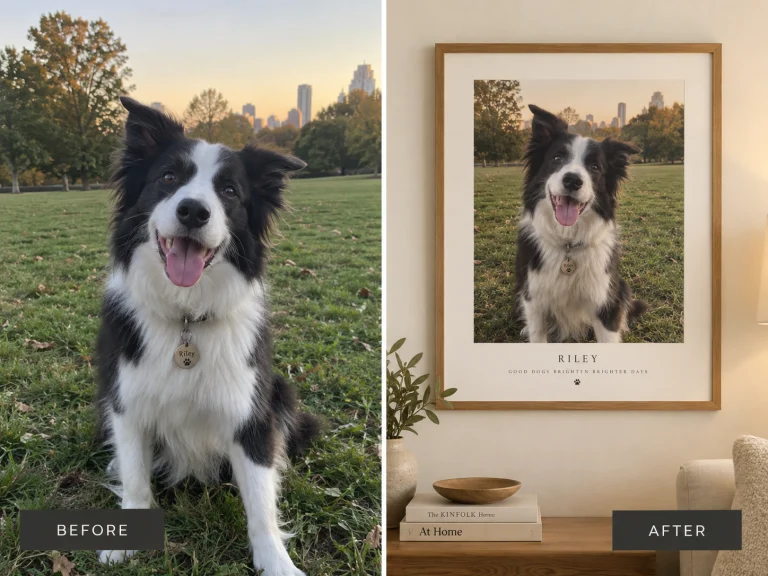
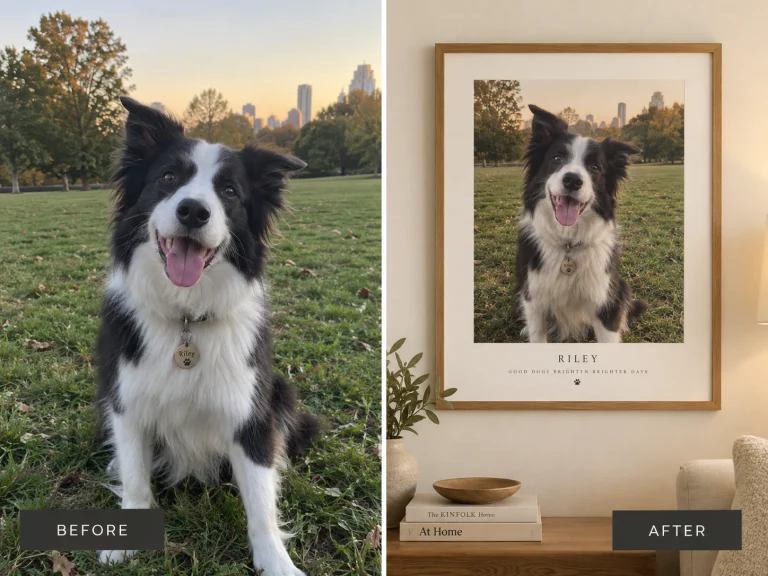
Pet memorial portraits work best when you begin with the photo that looks most like your dog, then track down its original, full-size file. Scan printed photos at 400 to 600 ppi if they will be enlarged, pick a style that photo can support, and hang the finished piece away from direct sun.
What makes pet memorial portraits different?
A portrait of a living dog can be reshot until it is right. With pet memorial portraits the archive is closed: the photos that exist are all there will ever be. That reverses the usual order.
Instead of choosing a style and then taking a photo to suit it, you look at the photos you have and choose a style they can carry. It also changes what the best photo means. The sharpest file might catch your dog mid-yawn, while a slightly soft one shows the head tilt, the grey muzzle or the ear that never stood up.
A memorial piece is also looked at closely and often, so small details matter: eye color, the collar they wore, one white paw. None of this runs on a deadline. Some people look through the photos in the first week; others wait a year before they can.
If your dog has only just died, set this guide aside for now. Our step-by-step guide to what to do when your dog dies covers the first hours, and nothing here needs deciding yet.
Gather every photo before you choose
Pictures of one dog tend to be spread across several phones, an old laptop, a cloud account and a few group chats. Put them in one folder first, and collect the originals rather than the copies that were passed around.
- iPhone and iCloud. With Optimize Storage switched on, Apple explains that the phone keeps space-saving versions while iCloud Photos stores the original, high-resolution files. Download the original before you send it anywhere.
- Google Photos. Backups made in Storage saver quality are compressed and resized to 16 megapixels if they were larger, according to Google’s help page, while Original quality keeps the file as it was taken. If the first phone or computer still exists, its copy may be the better one.
- Chats and social media. Messaging apps and social sites usually pass along a smaller, compressed copy. Ask whoever took the photo for the original file, sent as a file rather than dropped into a chat.
- Old cameras and memory cards. Files that went straight from a camera card to a computer were often never recompressed, so a ten-year-old photo can hold more detail than last month’s screenshot.
Once the folder is complete, keep at least two copies in different places, as the Library of Congress advises for any personal collection. These are the pictures you can least afford to lose.
Not ready to think about a portrait? That is fine. When you want to start with the photos, our photo guide shows what a sharp, printable photo looks like.
Scanning printed photos
For prints, a flatbed scanner beats a phone picture of the print, which adds glare and skew. The Library of Congress scanning guide gives clear settings: scan 4 x 6 and 5 x 7 inch photos at 300 ppi to reproduce them at the same size, and at 400 or 600 ppi if you want to enlarge them to 8 x 10 inches or more.
Save color scans as high-quality JPEG files when you plan to reprint them. Before you start, clean the glass and remove tape, clips and loose dust from the print.
Take the print out of its frame rather than scanning through the glass. If the only copy is small, faded or creased across the face, mention it when you order: color and small marks can usually be corrected, but detail the print never held cannot be recovered, only invented.
Choosing the photo that looks like them
- Expression before sharpness. The look you remember, whether a head tilt, a soft mouth or ears up for a squirrel, matters more than a tidy background, which an artist can replace.
- Eyes in focus. Zoom in on the eyes. If they are crisp, a slightly soft coat is forgivable; if they are blurred, the portrait will feel blurred however good the rest is.
- The age you want to remember. Puppy, prime years and grey-muzzled senior are three different portraits. There is no right answer, and nothing stops you choosing more than one.
- True color. Filters, beauty modes and warm indoor light shift coat color: a black dog can turn brown and a white dog yellow. Pick a daylight photo where you can, or send one as a color reference.
- Reference photos. A painter or illustrator can work from one main photo and use others for markings, eye color or the collar, so send three or four, not one.
Choosing a style for memorial pet portraits
Style is where the photo you have meets the look you want. Each option forgives different weaknesses, so match it to the biggest flaw in your photo.
| Style | What it keeps | Photo it needs | Suits |
|---|---|---|---|
| Retouched photo print | Exact likeness and real fur texture | The sharpest, largest original you have | One excellent photo you already love |
| Digital illustration | The likeness, with detail simplified | A clear face; soft focus and clutter are forgiven | Older or imperfect photos, or several photos joined |
| Painting on canvas or paper | An interpretation in real paint | Clear eyes, true color and extra reference photos | An original piece to keep for decades |
| Line or minimal portrait | Outline and character | Any photo that shows the shape of the head | Small frames, cards and very low-resolution files |
Text is part of the style too. A name, dates or a short phrase can sit under the image; keep it short, check the spelling twice, and decide whether you want dates at all. A name on its own can say enough.
Dog passed away quotes and short lines for a portrait
Most dog passed away quotes that suit a portrait are short enough to read from across the room: one line under the image, or a name and a line on the mat. If you borrow a line from a poem or a book, check the exact wording and the author against a published source before it is printed, because a mistake is hard to fix once it is framed.
The lines below are our own, written as quotes for a dog who passed away and free to use on a portrait, a card or a grave marker. Swap in your dog’s name, and cut any line down to the part that sounds like you.
- “Good dog. Best friend. Always.”
- “Thank you for every walk, Max.”
- “Loved every day. Missed every day.”
- “Still the first one we look for when we come home.”
- “The house is quieter, but you are in every room of it.”
- “Fourteen years of muddy paws, and we would take every one back.”
For a post or a message to friends, plain words work better than borrowed ones. “My dog just passed away, and I wanted you to know” is enough to start, and on an anniversary something like “Missing my dog who passed away a year ago today” gives people who knew your dog room to share a memory.
Adding people, a second pet or a favorite place
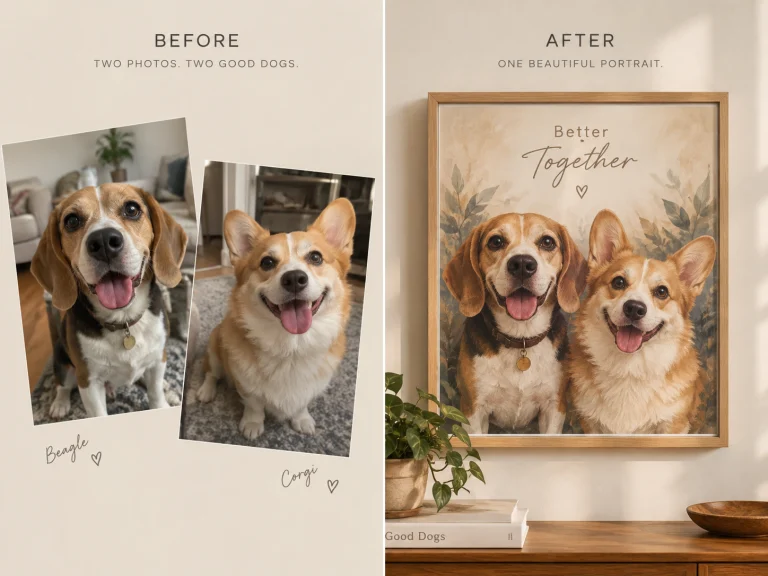
A memorial portrait does not have to show the dog alone. Illustrators and painters regularly combine a dog with the person who walked them, a surviving pet or a favorite view, working from separate photos. The result looks natural when the photos agree: light from the same side, a similar camera height and heads at similar angles.
A dog photographed from above next to a person photographed at eye level will look pasted in. For layouts with two animals, see our guide to two-dog portraits. If a place mattered, photograph it now, in the light you remember, even without the dog in it.
Hanging a memorial portrait so it lasts
The National Archives guidance on displaying family photos applies here. Exposure to all light, visible and ultraviolet, can cause fading and darkening, and the best protection is to display a copy while the original stays in a box. In a room with sunlight or fluorescent lighting, choose glazing with ultraviolet filtering, and use a mat or spacers so the glass or acrylic does not touch the surface of the picture.
In practice, hang the portrait on a wall that does not catch direct sun, and store the original print somewhere dark and dry. If the portrait is a print, keep its digital file so it can be printed again should it ever fade or be damaged.
When a memorial portrait is a gift
Cornell University’s pet loss resource lists art made in a pet’s honor among the ways people remember an animal, and a portrait can be a generous gift to someone whose dog has died. It also asks something of them, a photo and a reaction, so a few choices make it easier to receive.
- Let the family pick the photo. The favorite picture is personal, and the one you would choose may not be theirs. If you must keep it a surprise, ask a partner or relative which photo they love.
- Stay close to the photo. Unless you know their taste well, a faithful style is safer than a playful one.
- Choose a modest size, ready to display. A small framed piece can stand on a shelf or wait in a drawer; a large canvas needs a wall and a decision.
Ways to memorialize a dog alongside a portrait
A portrait is one of many ways to memorialize a dog, and Cornell’s resource lists several that sit well beside one. There is no right or wrong way to honor a pet’s life, in Cornell’s words, so take only the ideas that feel like yours.
- A marker in the garden. If your dog is buried at home, an engraved or painted rock, or a flower or tree planted on the spot, marks an animal grave without turning the yard into a cemetery.
- A corner with the portrait. Cornell suggests keeping the urn in a special place with a favorite photo and the collar, ID tag or a toy nearby, and a framed portrait belongs there naturally.
- The ID tag. Carried in a wallet or on a key chain, it goes wherever you go.
- Other people’s memories. Ask family and friends to write down a favorite memory of your dog, and keep the notes in a scrapbook with the photos.
- A gift in their name. A donation to a cause that mattered to you, or time given to a shelter or a rescue.
- A keepsake that holds a little of them. Some key chains, jewelry and ornaments are made to hold a small amount of ashes, fur or whiskers.
Pet memorial portrait questions
My dog has just passed away. What do I do before thinking about a portrait?
Look after the practical steps first; our guide to what to do when your dog dies walks through the first hours. The one portrait task worth doing early is copying the photos: gather the original files from every phone and account into one folder, and leave the decision about a portrait for later.
How soon after a loss should you order a memorial portrait?
There is no right time. Some people want something on the wall within weeks; others cannot look at photos for months. The photos will keep, as long as they are copied somewhere safe, so the decision can wait until it feels possible.
I miss my dog that passed away. Will a portrait help?
It can: Cornell’s pet loss resource lists art made in a pet’s honor among the ways to remember an animal, and it suggests putting grief into words, writing or art. If a large portrait on the wall every day feels like too much, start with a small framed print that can sit on a shelf or wait in a drawer.
Can a blurry photo still become a memorial portrait?
Often, yes, in the right style: an illustration or painting rebuilds detail from the shapes and colors in the photo, so softness matters less than in a photo print, which shows every flaw. A smaller size helps too. Blurred eyes are the hardest thing to work around.
What if the only photos are on someone’s social media?
Download the largest version the site offers, then ask the person who posted it for the original file, which is usually bigger and sharper. If no original exists, choose an illustrated or line style that does not depend on fine detail.
What scan resolution does an old print need?
The Library of Congress suggests 300 ppi to reproduce a 4 x 6 or 5 x 7 inch photo at the same size, and 400 or 600 ppi to enlarge it to 8 x 10 inches or more. Scan the print itself, out of its frame.
Is a painted portrait better than a printed one?
Neither is better; they do different jobs. A print keeps the photo’s exact detail, while a painting is an interpretation made by a person, slower to produce and different every time. Our guide to painted and digital portraits compares them in detail.
Does MyDogPics make memorial pet portraits?
Yes. MyDogPics makes custom dog portraits and memorial gifts to order from one photo you upload, and each product page lists its size, material and options. We check every photo before printing and email you if it is too small, dark or blurry to print well.
Gift ideas for every dog person: who a memorial portrait is for
A memorial portrait can be a gift, and this section is for the person who might receive one and the people who love them. Each card names who they are, what is hard for them and what this guide suggests.
Dog moms
A dog mom who has lost her dog may find the house empty at the hours they used to share. A portrait made from her favorite photo can wait on a shelf until she wants it. Let her choose the photo, because the face she remembers is not always the sharpest one.
Dog dads
A dog dad often misses the walks without saying so, and he can be hard to shop for even in good times. A small framed portrait of his dog asks nothing of him. Pick a modest size that can sit on a shelf.
Gift buyers for a dog lover
If a friend or coworker has lost a dog, many people worry about saying the wrong thing. Ask a relative which photo the family loves, and put the dog’s name on the card. The gift section above suggests a faithful style and a modest size.
Kids and parents
Parents worry when a child has lost the family dog and goes quiet. Let the child help pick the photo, and keep any portrait small enough to hold. Our guide to what to do when your dog dies covers talking with children.
Matching family
In a family, one person’s grief is often louder than another’s, and the quiet ones feel left out of the plan. Ask each person for a favorite photo before anyone orders. A portrait everyone chose hangs more easily than one picked alone.
Couples
A couple who shared a dog may each be missing the dog in a different way, and an anniversary can bring it all back. Choose the photo together, so the portrait is something you both agreed to keep.
Grandparents
Grandparents who live far away from the family may hear the news by phone and have no photo of the grand-dog nearby. A portrait for their home, made from a photo the family chose, gives them a face to look at. Ask the family first.
New puppy owners
Someone who adopted a new dog after a loss can feel awkward about missing the old one. A portrait of the dog who passed away keeps both stories in the house. Nothing says one dog has to replace the other.
Holiday and occasion gift buyers
A holiday or birthday can reopen the loss, and a portrait wrapped as a big surprise adds pressure. Give it quietly, and let the person decide when to hang it. Choose a modest size that is ready to display.
Grieving owners
If your own dog has passed away, the house may feel empty, and nothing here has a deadline. Copy the original photos first and let the rest wait. A portrait can come later, or never.
Multi-dog households
In a home with two dogs, the one who is still here can end up left out of the keepsake plans. Photos of both, taken in light from the same side, can be joined into one portrait where a design takes more than one dog. Our two-dog portraits guide covers layouts.
Self-purchasers
Ordering a portrait for yourself in the middle of grief can feel awkward, as if you should wait for an occasion. You do not need one: just because you want the face where you can see it is enough. A small framed piece can stand on a shelf or wait in a drawer.
How MyDogPics makes memorial portraits
MyDogPics makes custom dog portraits and dog memorial gifts to order from one photo you upload on the product page. Each product page lists its size, material and options.
We check every photo and prepare the artwork before anything is printed; if a photo is too small, dark or blurry to print well, we email you for another one, and there is no proof step to wait for. The piece is printed after you order and shipped to a US address with USPS tracking, and current production and delivery times are on the shipping page.
The advice above applies to your order as well: a close, sharp, well-lit face in its original file prints best, and our photo guide shows good and bad examples side by side. We keep your photo for 12 months after the order and delete it sooner if you ask.
Whenever you are ready, the photo you chose can become a portrait or a keepsake. We check it before anything is printed, and nothing needs deciding today. There are also 30 days to have it remade or refunded if it arrives with a print defect, damaged or wrong. Free US shipping on every order, and your 2nd item is 25% off in the cart, automatically.
Sources
- Library of Congress — Scanning Your Personal Collections (PDF)
- National Archives — Displaying Family Papers and Photographs
- Apple Support — Set up and use iCloud Photos
- Google Photos Help — Choose the backup quality of your photos and videos
- Cornell University College of Veterinary Medicine — Pet Loss Resources and Support
Related guides: What to do when your dog dies · Dog memorial gifts · Custom dog portraits · All dog memorial guides
Last reviewed: September 25, 2026
