Dog Photo Products
Custom Dog Blanket: Name vs Photo Designs
Sep
Short answer
A photo design puts your dog’s actual face on the blanket, while a name-only design uses text and simple graphics instead — the photo version is the better choice if you want the blanket to be instantly recognizable as your specific dog, and the name version works well if you’d rather have a clean, decorative look that doesn’t depend on print quality. This comparison is part of what people mean by the best pet photo blanket for their situation.
What to look at before you decide
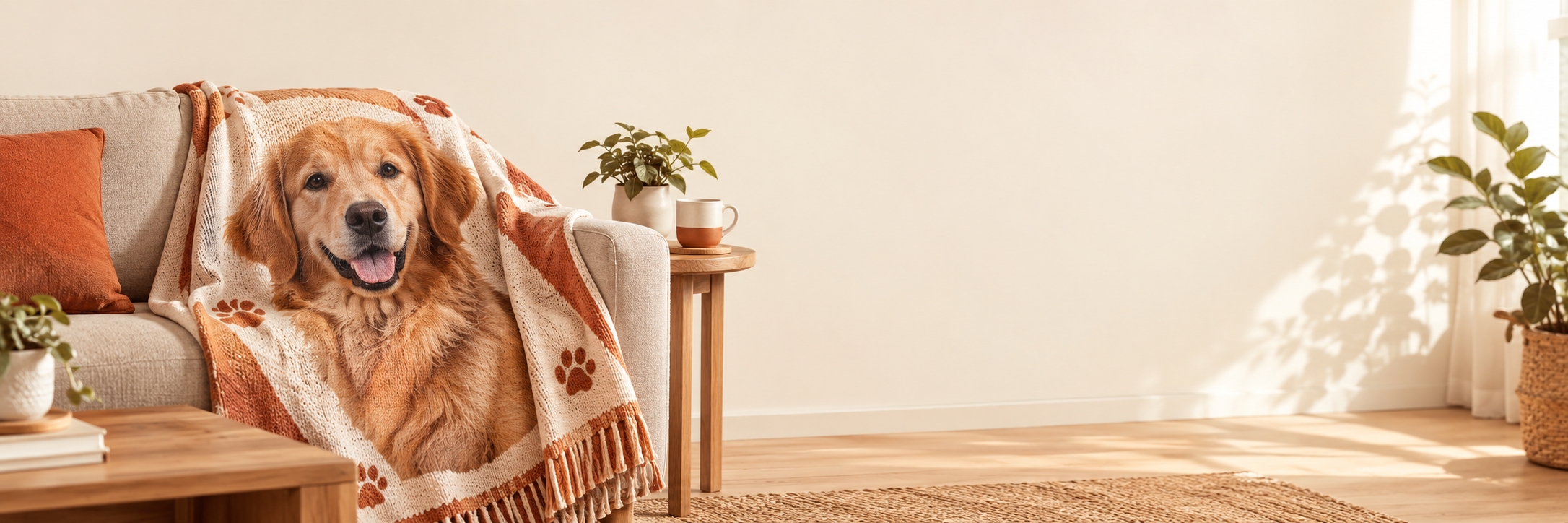
The two design styles solve different problems. A custom dog blanket built from a photo is meant to look like your dog — the fur pattern, the markings, the exact expression. A name-only or illustrated design is more forgiving: it doesn’t rely on one specific photo turning out well, and it tends to read cleanly from across a room. If your goal is a keepsake that captures one specific dog, lean photo. If your goal is a decorative throw that just needs to say “dog person,” a name or icon-based design is usually the simpler pick.
There’s also a practical angle worth thinking through before you choose: who is the blanket for, and how long do you expect to use it? A photo blanket tends to stay relevant for as long as you have that dog (or as a keepsake afterward), since it’s tied to a specific animal rather than a general theme. A name-only design can be easier to pass along as a general “dog lover” gift if you’re buying for someone whose dog you don’t have a great photo of yet.
How the two styles actually compare
Photo-based blankets depend heavily on the source photo. A sharp, well-lit, front-facing photo (see our photo guide for what that looks like) will produce a blanket that clearly reads as your dog. A blurry or dark photo will still print, but the result will look soft or muddy no matter how good the blanket material is. Name and text-based designs don’t have this dependency — the design is built from typography and simple shapes, so the outcome is more predictable and less sensitive to photo quality.
The tradeoff is personalization. A name-only blanket says “this is a dog blanket” in a general sense. A photo blanket says “this is this dog,” which is usually the whole point of buying one as a gift or a keepsake. If you’re on the fence, ask yourself which sentence better describes what you want the finished product to say.
Layout is another point of difference. Photo blankets typically place the face as the focal point, sometimes with a name added underneath or in a corner — effectively combining both approaches. Name-only designs have more flexibility in font, color and layout since there’s no photo to work around, which can make them easier to match to a specific room or color scheme.
Sizing and how you’ll actually use it
Beyond the design style, think about how the blanket will be used day to day. A smaller throw-style blanket works well draped over a chair, a couch arm, or a dog bed, while a larger size is better suited to covering a full couch or bed. Whichever design you choose, check the listed dimensions on the specific product rather than judging size from the preview photo alone, since photos can make products look larger or smaller than they are.
If the blanket is going to get regular daily use — on a dog bed, in a car, or on a couch your dog is allowed on — a busier photo-based design can be more forgiving of everyday wear and the occasional stain, since the eye is drawn to the face rather than the overall fabric condition. A more minimal name-only design on a light background can show wear more visibly over time.
Buying it as a gift vs. keeping it yourself
The decision can shift depending on who the blanket is for. If you’re buying it for yourself, you already know exactly how good your photo is and can pick accordingly. If you’re buying it as a gift, you may be working from whatever photo you can get of someone else’s dog, which is a good reason to lean toward whichever style is more forgiving of a photo you didn’t take yourself and can’t easily retake. A name design sidesteps that risk entirely, while a photo design rewards having a genuinely good photo to work with.
Mistakes to avoid
- Uploading a small, heavily compressed, or screenshot-quality photo and expecting portrait-level detail — the source photo is the ceiling on how good the print can look.
- Choosing a photo where the dog is mostly in shadow or backlit; the design process can’t recover detail that isn’t in the original photo.
- Assuming a name design needs no photo at all — some name-style layouts still use a small photo or silhouette element, so check the product’s exact layout before ordering.
- Picking a size purely from the product photo instead of checking the actual listed dimensions.
FAQ
Can I combine a photo and a name on the same blanket?
That depends on which layout option the specific blanket listing offers — check the product page for the exact layout choices available.
Does a dark-colored dog work as well as a light-colored one in a photo design?
Yes, as long as the photo is well-lit enough that fur detail and markings are visible; the biggest factor is lighting, not coat color.
What if I only have an older, lower-resolution photo?
Use the highest-resolution version of that photo you can find. See the photo guide for what to check before uploading.
How do I know what the finished blanket will look like before it’s made?
There is no proof step — we print from the photo you upload, which is what keeps the turnaround short. Every photo is checked first, and we email you if it will not print well. See How It Works.
Is a name-only design a safer choice if I’m not confident in my photo?
It can be, since it doesn’t rely on photo detail the way a photo design does — but a well-lit, in-focus photo (see the photo guide) usually produces a strong result too.
Related guides: Best Custom Dog Pillow Buying Guide · Best Custom Dog Socks: Face Crop, Fit and Print Quality
Last reviewed: September 12, 2026
