Dog Portraits
Two Dog Portraits: Photos, Layouts and Sizes That Work
Sep
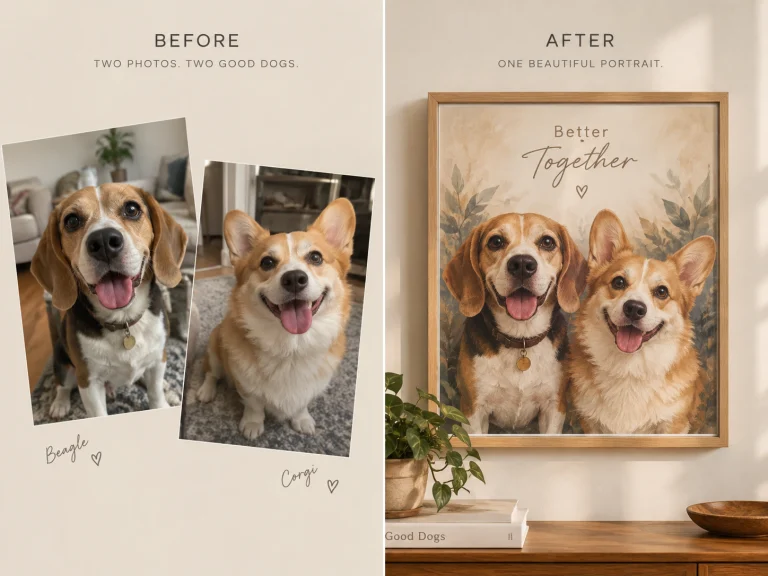
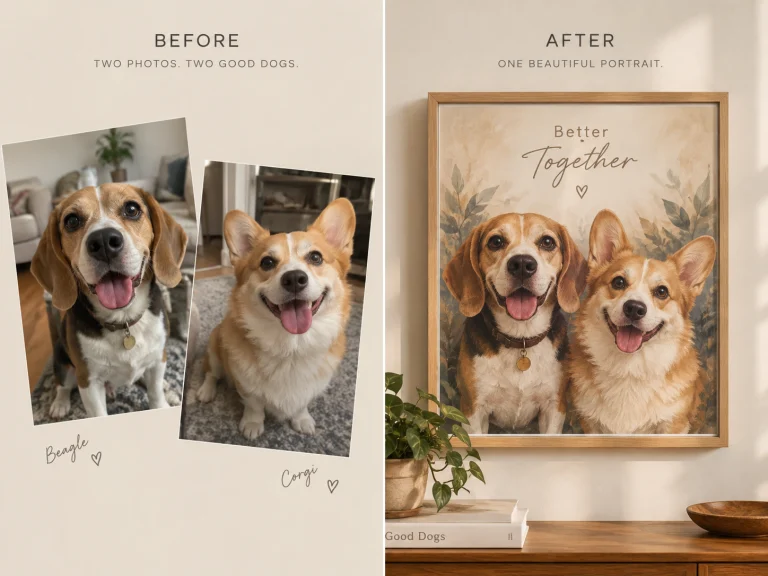
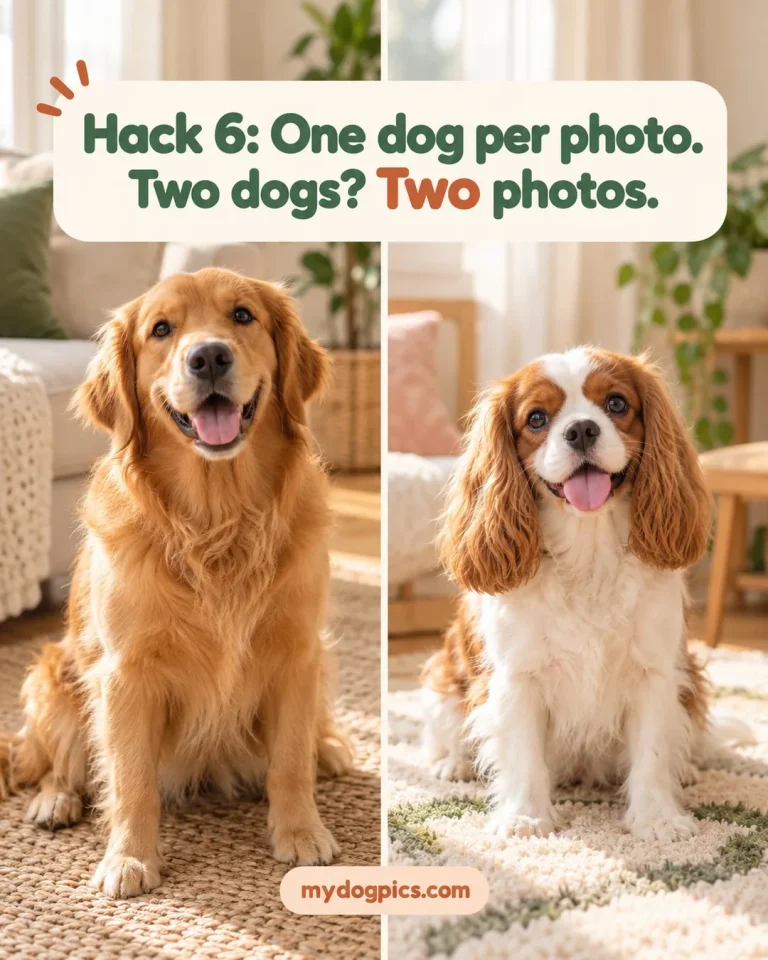
Two dog portraits work best from one sharp photo per dog, taken at each dog’s eye level, from the same distance and in the same light, then combined by the artist. A photo of both together helps only if both faces are sharp. Size the piece around the faces: every extra dog needs more canvas to stay recognizable.
For both dogs on one MyDogPics design, upload one sharp photo per dog; each product page shows how many dogs it takes.
Two dog portraits: one shared photo or one photo each?
Most people start by hunting for a picture with both dogs in it. It is the obvious route, and often not the best one.
A shared photo gets three things right by default: the dogs’ real size difference, the way they lean into each other, and matching light. What it rarely gets right is two sharp faces. One dog blinks, one turns away, or one sits a step behind and falls out of focus.
Nikon School’s guide to depth of field explains the fix for that last problem: to keep two subjects at different distances sharp, use a larger depth of field and focus on the midpoint between them. On a phone, that means stepping back a little, keeping both dogs the same distance from the lens and switching off portrait mode, whose background blur can soften the dog further back.
Separate photos let each dog look its best, taken whenever that dog is calm and awake. The cost falls on the artist, who has to reconcile light, angle and scale. The usual answer is to send both: the shared photo as the layout reference and separate close-ups for the faces.
Matching light, angle and distance across two photos
Separate photos only blend when they were taken the same way. Photograph both dogs at the same time of day and in the same spot, each from its own eye level, crouching lower for the shorter dog, and from about the same distance, because a phone held close to one dog’s nose enlarges it next to the other.
Light color matters most. Nikon’s beginner’s guide to white balance puts tungsten light at around 3200K and daylight at around 5500K, and warns against mixing the two. Nikon USA explains that our eyes compensate for different light while a camera needs help to do the same.
A dog photographed under a lamp can come out orange beside one photographed by a window, and the artist then has to guess which coat is true. If you cannot reshoot, say which photo shows the real colors.
Layouts for two dogs, or more
The layout decides whether the finished piece reads as a pair or as two separate cutouts on one background. Pick it before you choose the photos, because some layouts need particular poses.
- Side by side, heads level. The classic, and the right choice when the dogs are close in size.
- Overlapping. One dog slightly in front of the other reads as a real pair. Decide who goes in front, because the dog behind loses part of its body.
- Staggered. For a tall dog and a short one, set the heads on a diagonal instead of forcing them level.
- Facing each other. This needs photos with the heads already turned inward. Flipping a photo to make a dog face the other way mirrors its markings, so a blaze that leans left, or the one brown ear, ends up on the wrong side. Tell the artist about any one-sided markings.
- Two matching panels. Each dog gets its own canvas in the same size and background, hung as a pair. This suits photos taken years apart or in very different light.
- Three or more dogs. Arrange the heads in a loose triangle or an arc; a straight row tends to crowd whoever sits in the middle.
Scale: when one dog is a Chihuahua and the other a Great Dane
A portrait can show dogs at true scale or at equalized scale, and it pays to choose before the artist starts. True scale in a full-body pose is honest and often funny, but the small dog’s face can end up tiny.
A head-and-shoulders crop evens out the difference, because both heads can be painted at similar sizes. A middle route keeps true scale but brings the small dog forward, onto a chair or between the big dog’s front paws, as long as a real photo supports the pose.
Whichever you pick, send one photo of both dogs standing together, even a poor one, so the artist knows their real proportions. Height at the shoulder, head size and ear length are easy to misjudge when every photo was taken at a different distance.
Sizing the canvas for a two pet portrait
A two pet portrait needs more width than a single portrait if each face is to stay the same size. Start from a single-dog portrait you would be happy with and keep each face at least that large; two heads side by side need roughly twice the width, which is why pairs suit landscape formats. Measure the wall before you order, and remember that a frame adds to the outside size.
For a printed digital portrait, each dog’s photo has to hold up at the size its head will print. Canon’s printing guide notes that cropping reduces the pixel count, so a dog cut out of a wide group shot may not have enough pixels left for a large head. As a quick check at 300 pixels per inch, a head printed 4 inches wide needs about 1200 pixels across the head in the original photo.
Expect the price to rise with each extra pet too, for the extra likeness and the bigger surface; how to compare custom pet portraits covers the other price drivers. For a custom dog portrait from MyDogPics, each product page shows its price and lists its size, material and options.
Adding a dog who has died
Many families want a dog who has died shown beside the dog they have now. The photos are usually uneven: the older one taken indoors, on an older phone, years before the other.
Choose the sharpest face photo you have of the dog who died, even if the pose is wrong, because the artist can pose both dogs to match. Tell the artist which photo shows that dog’s true coat color, and whether the two should look at each other or out of the frame. If this is where you are, the memorial portrait guide goes through choosing among the photos you have, gently and without rushing.
Two dogs on pajamas: one photo per face
A portrait is not the only way to keep two dogs together. MyDogPics also makes multi-dog gifts, including pajamas that carry more than one dog. On fabric, each dog’s face is cut out of its own photo and repeated across the garment, so backgrounds and body poses matter far less than on a portrait, and a sharp close-up of each face matters more.
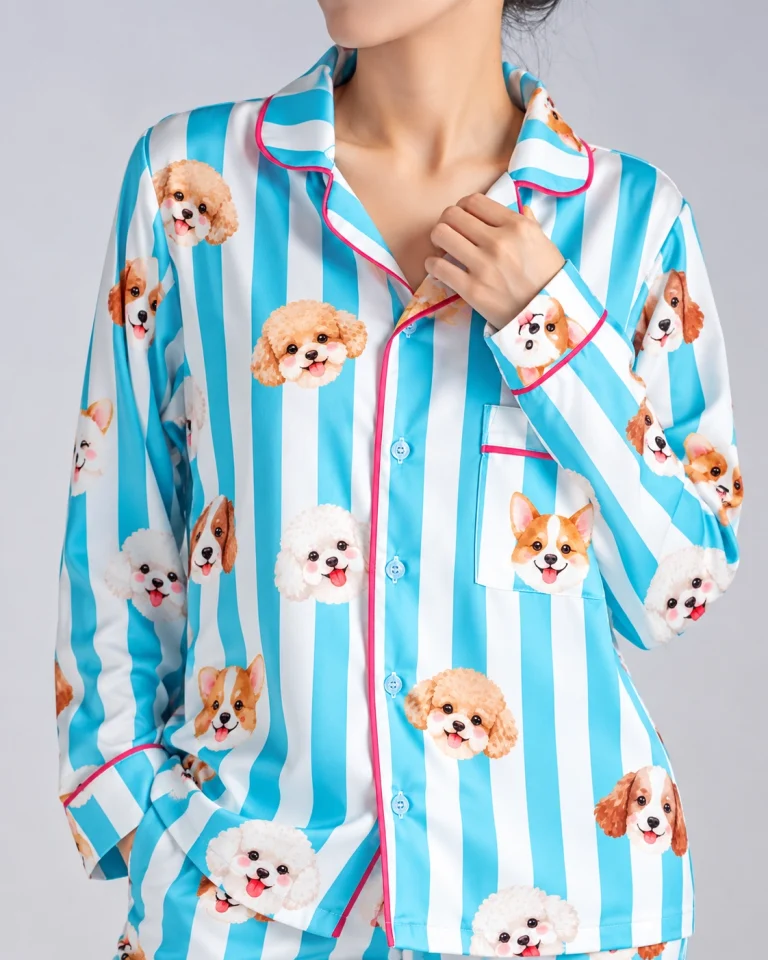
The photo rules are short: one dog per photo and one photo per dog, the whole head in frame, soft daylight, and the original file rather than a screenshot. Each product page shows how many dogs that design takes.
MyDogPics checks every photo before printing and emails you for another if one is too small, dark or blurry. You can also browse all dog face pajamas.
Custom dog portraits from MyDogPics
Open any portrait below to check its size, material and options before you upload a photo.
Two dog portrait questions
Can two dogs be painted from separate photos?
Yes, and it is often the better route, because each dog can be photographed at its best. The photos should match in light, time of day and camera height. Send a photo of the two together as well, even a poor one, so the artist can see their real size difference.
How much more does a portrait of two dogs cost?
There is no fixed rule, but expect more than for a single portrait: each face is another likeness to get right, and a pair usually needs a larger canvas or print. Ask sellers to quote the same number of pets, size and framing so their totals compare fairly.
What size should a two-dog portrait be?
Choose a size that keeps each face as large as it would be in a single portrait you like, which usually means a wider, landscape format. Measure the wall first and allow for the frame. Above a sofa or a bed, a wide piece tends to balance better than a tall one.
Can a dog and a cat be in the same portrait?
Yes. The same rules apply: one sharp photo per animal, taken in similar light, and a clear note about which animal sits in front. Cats are harder to catch at eye level, so take a series of shots and pick the sharpest one for the face.
Should both dogs look at the camera?
Not necessarily. Two dogs staring straight out can look posed, while one glancing at the other reads as a relationship. What matters is that both faces are sharp and that the artist knows which way each dog should face, since flipping a photo mirrors the markings.
How many dogs fit on a MyDogPics multi-dog design?
It depends on the design: each product page shows its own limit. Every dog needs its own photo, one dog per photo, sharp at the eyes and with the whole head in frame. The multi-dog collection lists the designs made for more than one dog.
Portrait or multi-dog gift, MyDogPics checks every photo before printing, so start with one sharp close-up of each dog.
Sources
- Nikon School — Understanding Depth of Field
- Nikon — The beginner’s guide to white balance
- Nikon USA — Setting White Balance
- Canon — Digital Photo Printing Guide: Numbers of Pixels and Print Sizes
Related guides: Dog paintings from photos · Painted versus digital portraits · Custom dog portraits · Royal portraits for a pair · All dog portrait guides
Last reviewed: September 25, 2026
